

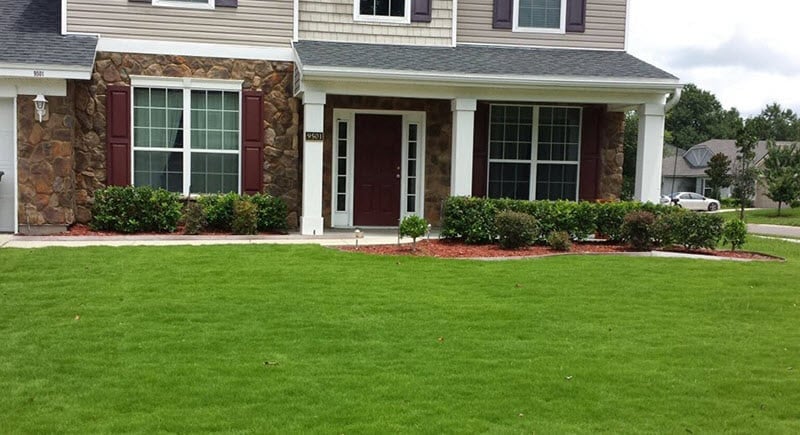

Emerald is a beautiful lawn, but we have switched to growing Zeon as the premiere fine-bladed Zoysiagrass. It's also more disease resistant. We have kept these maintenance tips as a courtesy to those with Emerald lawns.
Subscribe to our Monthly Lawn Tips Email and we'll send you lawn care alerts and timely tips. That way you don't need to bookmark this page because we'll email you what to do every month. Our general Zoysia tips will still apply to Emerald.

Mowing Emerald Zoysia Sod
- Mow at 1.5" cutting height.
- Mow no more than 1/3 of the leaf off at one mowing. Use sharp mower blades and catch and remove clippings. Mow with a rotary or reel mower.
- Less frequent mowing requirements (second only to Centipede) - mowing may be required on a 7-to-10-day interval.
| Mow when grass is this tall: | 1.5 to 2 inches (5 cm) |
| Set cutting height of mower to: | 1 to 1.5 inches (3.7 cm) |
Watering Emerald Zoysia Sod
Water to supplement rainfall shortages only. Avoid fixed timer irrigation settings.
Though drought tolerant, Zoysia best performs when it receives approximately 1" of water per week. If one or more inches of rainfall occurs in a week, additional irrigation is not necessary. Example: if 1/2" of rain occurs within a growing week, apply 1/2" by irrigation.
Do not waste water by over watering; avoid run-off and standing water for any period of time. (Read How and When to Water)
Fertilizing Emerald Zoysia
- Apply between 2 and 3 pounds of nitrogen per 1000 square feet annually, during the growing season. Select a fertilizer that is labeled for use on Zoysia grass lawns. Do not apply fertilizer to wet turf to avoid burning. Too much fertility will result in a thatchy, unhealthy lawn and increased disease risk.
- Once Emerald turf is matured, apply moderate nitrogen according to the table below. It can maintain good density and color and need cutting only every 10 days at low fertility levels. Higher fertilizer levels produce deeper color, but more growth means more frequent mowing and increased risk of diseases.
- Fertilize according to the table below and according to soil test recommendations.
- Special note: don’t fertilize your Emerald Zoysia lawn with high Nitrogen fertilizer in fall or winter.
- Read about How to Calculate Fertilizer Rates.
- Supplemental application of iron will improve grass color, but most Super-Sod fertilizers already contain iron.
- Lime can safely be applied any time of year. Lime based on feedback from soil test recommendations.
Weed Control for Emerald Zoysia
- Emerald Zoysia's dense growth can retard weed infestation, however the best weed control is preventive:
- Regular mowing
- Pre-emergent herbicide, recommended for use on Zoysia lawns on the label, is strongly recommended in the spring and fall
- Apply pre-emergent and post-emergent weed control products that are specifically labeled for Zoysia lawns.
- Apply pre-emergent weed control according to the table below. Read and follow herbicide label directions.
- Apply post-emergent weed control to weeds you can see, as needed.
- Special note: While Zoysia is a very dense grass that crowds out some weeds, the reality is that Zoysia lawns require herbicides to prevent weed infestations.
- For assistance with weed identification and pest control contact your nursery/garden center, landscaper, or local Cooperative Extension Service agent, or browse our Weed of the Month section.
Look up Super-Sod's yellow spreader settings here.
Month |
Fertilizer & Weed Control (lbs/1000 sq.ft.) |
Timing |
| FEB | 0-0-7* + Iron w/ pre-emergent @ 6 lbs. | first week |
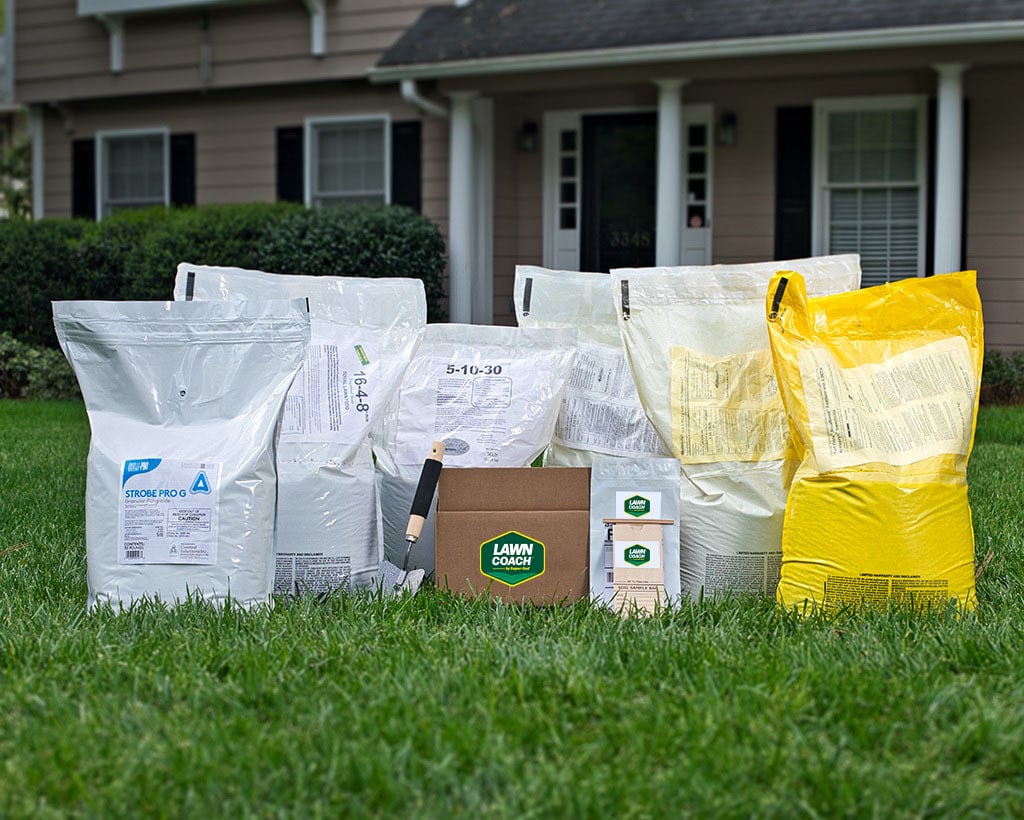
| APRIL | 16-4-8 + Iron w/ pre-emergent @ 6 lbs. | after last frost |
| JUNE | 16-4-8 + Iron @ 6 lbs. | middle of month |
| JULY | 5-10-30 + Iron w/ Acelepryn (insecticide) @ 5 lbs. | middle of month |
| AUG | 5-10-30 + Iron @ 5 lbs. | middle of month |
| SEPT | 0-0-7* + Iron w/ pre-emergent @ 6 lbs. | middle of month |
*Low nitrogen

Additional Maintenance for Emerald Zoysia
- Pests can become a problem, especially if Zoysia is not growing healthily (too much fertility or water, etc.).
- Fungus Control: Zoysia Patch disease (Rhizoctonia fungus) can be a problem on over-fertilized lawns. Due to our cold, wet winters, we recommend applying fungicide to Zoysia lawns according to this schedule.

Month |
Fungicide |
Timing |
| APRIL | Professional fungicide | middle of month |
| OCT | Professional fungicide | middle of month |
- Some rust may be expected in cool spring weather and other leaf diseases may show up in hot, humid weather, but the grass will usually recover if water and fertility levels are minimized.
- Soil insects such as grubs and mole crickets are minimal problems.
- Grubs and bill bugs (plus mole crickets in the Lower South) are soil-borne insects which can cause damage.
- Thatch Removal: Periodically it may be necessary to remove accumulated thatch. This is best accomplished just before turf turns green (which is approximately late winter in the coastal plain and spring further north). Scalp with a lawn mower or de-thatch with a commercial machine and remove debris.